The Standard Dimensions of a Wallet Card
In the United States and Canada, the standard business card measures exactly 3.5 inches wide by 2.0 inches high. This conventional format matches standard cardholder slots in wallets, rotary card organizers, and desktop card caddies. While European and Asian markets lean toward slightly different dimensions—most notably the 85 millimeter by 55 millimeter format common across Europe—the North American 3.5-by-2-inch card remains the dominant expectation across virtually every domestic industry.
When setting up a graphic file for professional output, the actual digital canvas must extend slightly beyond these final finished dimensions. Commercial presses trim batches of cards using high-pressure hydraulic blades, and paper shifting can occur during the slicing process. To avoid unwanted white borders around full-bleed artwork, print templates typically require a 0.125-inch bleed on all four outer sides, expanding the pre-cut document canvas to 3.75 inches by 2.25 inches.
Equally important is the safe zone, often defined as an internal margin resting 0.125 inches inside the planned cut lines. Any critical typography, telephone numbers, web addresses, or company emblems should remain within this 3.25-by-1.75-inch inner boundary. Keeping vital text away from the mechanical trim line ensures that minor shifts on the cutting table will never slice through contact numbers or personal titles.
Alternative formats exist, such as square profiles measuring 2.5 by 2.5 inches, slender mini-cards measuring 3.5 by 1.25 inches, or folding cards with a center crease. However, deviating from the classic rectangular shape creates practical hurdles for recipients. Non-standard dimensions rarely fit neatly into standard credit card pockets, often leading to bent corners or cards getting tossed into desk drawers rather than kept close at hand.
Understanding Paper Weight and Card Stock Thickness
Paper thickness in commercial card manufacturing is generally measured in points, where one point equals one one-thousandth of an inch. A standard everyday card stock sits between 14-point and 16-point caliper thickness, which roughly corresponds to 300 to 350 grams per square meter. In everyday terms, a 14-point stock feels sturdy enough to resist minor folding during an exchange, while a 16-point sheet provides a distinctly firmer, professional backbone in the hand.
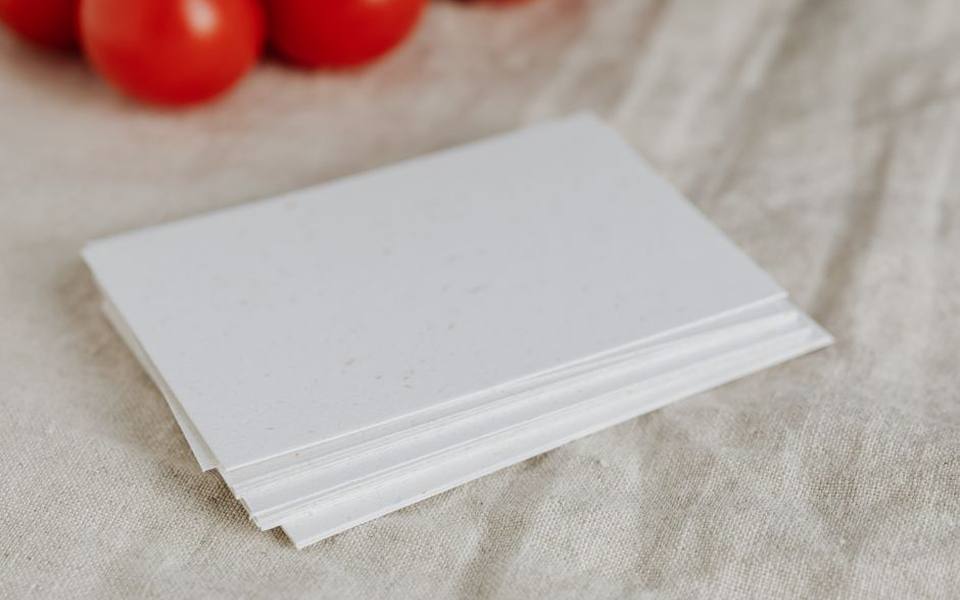
Economy-tier runs occasionally use 10-point to 12-point card stocks to minimize material and shipping expenses. These thinner substrates tend to bend under light thumb pressure and can feel flimsy to an experienced contact. On the opposite end of the spectrum, luxury cards often utilize 18-point, 24-point, or even double-thick 32-point pasted paper stocks. These heavier weights communicate permanence and premium craft, though they quickly fill wallet compartments.
Selecting the proper caliper depends on your operating environment and personal brand positioning. Tradespeople, field technicians, and construction estimators frequently choose 16-point or heavy synthetic plastic materials that hold their shape inside toolboxes and damp pockets. Creative studios and law practices often select heavy uncoated cotton sheets that convey substantial weight without relying on artificial plastic laminates or synthetic surface treatments.
What You Can Expect to Pay for a Run
Business card pricing hinges directly on production volume, stock selection, and finishing embellishments. A basic run of 250 to 500 standard cards on 14-point stock typically ranges between twenty and fifty dollars through most regional outlets. Because commercial equipment requires preliminary calibration and plate or digital setup regardless of quantity, printing 1,000 cards rarely costs twice as much as printing 500, offering clear economies of scale.
Premium upgrades alter the pricing structure substantially. Adding tactile soft-touch laminates, raised spot gloss coatings, metallic foil stamping, or color-edged painted cores can easily push the total invoice into the seventy-five to one hundred fifty dollar range for an equivalent batch. These embellishments require multi-stage passes through specialized press units or supplementary offline curing machinery, raising labor requirements.
Keep in mind that order volume influences shipping fees and per-card economics. Ordering micro-batches of 50 or 100 cards often results in a steep per-unit penalty, frequently costing almost as much as a 250-card box due to baseline setup labor. For established enterprises with unchanging contact information, committing to 500 or 1,000 units per representative offers the most economical pathway over twelve to eighteen months.
Finding Same-Day Turnaround in Your Neighborhood
When an unexpected networking conference or trade convention arises, waiting five business days for freight delivery is not an option. Neighborhood print shops and urban copy hubs frequently handle same-day production, provided digital files arrive before morning production cutoffs. Many print providers across metropolitan regions, such as retail printing facilities featured among places to print in California, offer digital color xerography that bypasses slow-drying lithographic inks.
Same-day turnaround typically relies on digital toner presses rather than wet-ink offset machinery. Toner instantly fuses to the sheet through heated rollers, allowing workers to run sheets directly to the computerized guillotine cutter within minutes of the final print pass. If you require walk-in production where you manage basic document handling yourself, visiting local centers that offer self-service printing can help verify files before handing complex jobs over to counter technicians.
Expect a realistic premium when requesting expedited production within a four- to eight-hour window. Shops typically levy a rush charge ranging between fifteen and forty dollars, or they may restrict paper selections exclusively to standard 14-point house stock already loaded in active paper trays. Specialty treatments like debossing or foil cannot be produced same-day, so rush designs should stay focused on crisp two-sided digital CMYK layouts.
Choosing Between Online Platforms and Local Print Shops
Selecting the ideal vendor involves weighing cost efficiencies against hands-on verification and personalized service. Large nationwide internet platforms operate massive centralized manufacturing hubs that produce vast quantities on unified sheet gang-runs. This model delivers competitive baseline prices, but customers forfeit the ability to physically inspect paper samples, check press-run proofs, or adjust color balance before the complete batch moves into production.
Conversely, working with an established local print house gives you direct access to experienced press operators who evaluate file fidelity, color separations, and trimming tolerance. Whether you consult independent shops in the Midwest or browse places to print in Texas, local operators can provide physical sample decks showing exact paper textures. If a specific brand color must match a corporate style guide, a local counter specialist can manually tweak output profiles to match.
Delivery reliability represents another major divide between service models. Web orders remain vulnerable to transit delays, winter weather hold-ups, and parcel damage during shipping cycles. Partnering with a neighborhood print center eliminates carrier uncertainty, allowing direct counter pick-up the moment the trimming department boxes your finished order.
Coatings, Finishes, and Card Longevity
The protective surface applied over raw paper stock profoundly influences how the card wears over months of pocket storage. Uncoated sheets deliver an organic, tactile paper texture that accepts pencil notes, ballpoint ink, and rubber stamps effortlessly, making them favorite choices for appointments and medical practices. However, uncoated paper absorbs environmental moisture and skin oils more rapidly, which can cause corners to soften quickly.

Gloss aqueous and ultra-violet liquid coatings seal the sheet under a durable, reflective shield that makes saturated photographs and dark graphics stand out. While gloss resists edge scuffing and moisture transfer, it produces reflective glare under direct lighting and rejects standard pen ink, complicating handwritten notes. Semi-gloss satin or dull matte finishes offer a balanced middle ground, lowering glare while retaining moderate scuff resistance.
For a distinct sensory profile, soft-touch matte lamination bonds a velvety plastic film directly to the card faces. This finish imparts a subtle suede-like feel while reinforcing the overall thickness and water resistance of the card. Because lamination prevents paper fraying, cards with soft-touch films retain sharp, crisp edges even after weeks of riding inside crowded briefcases or leather pocketbooks.
Preparing Your Digital Files for Production
Achieving crisp lettering and accurate color balance requires strict adherence to prepress production rules. Graphic files must always be prepared in the CMYK color spectrum rather than the RGB space used for computer monitors and mobile screens. Vibrant electric blues and glowing neon greens visible on back-lit glass will shift into muted, darker tones when translated into standard cyan, magenta, yellow, and black commercial inks.
Image resolution should sit at a minimum of 300 dots per inch at 100 percent scale to prevent pixelation along typography and photographic assets. Wherever possible, company emblems, illustrations, and body copy should remain in vector format rather than rasterized bitmap artwork. Vector artwork relies on mathematical curves rather than fixed pixels, guaranteeing razor-sharp edges on the finest serifs and line weights.
Prior to exporting your finalized print-ready PDF, convert all typography into outlines or paths. If your graphic document references proprietary typefaces that the print center's prepress system does not possess, automatic font substitution may corrupt your layout during plate output. Outlining letters permanently freezes font architecture into shapes, ensuring what you review on your workstation matches the physical card exactly.
Mailing and Shipping Cards Overseas
Distributing printed marketing collateral or replacement staff cards to international field branches requires realistic cost planning. When using United States Postal Service international channels, mailing rates for parcels depend on combined weight, package volume, and destination pricing groups. Even a compact box of 500 standard business cards, when packed inside protective corrugated cardboard with cushioning, typically weighs between one and two pounds.
For parcels within this weight bracket, First-Class Package International Service often presents the most economical baseline rate, typically starting between eighteen and thirty-five dollars depending on whether the destination falls into North American, European, or Asia-Pacific postal bands. However, First-Class international parcels do not always provide end-to-end milestone tracking once the carton transfers to regional national carriers overseas.
If firm delivery dates and verified tracking checkpoints are required for corporate events abroad, Priority Mail International or Priority Mail Express International become the practical pathways. Rates for standard flat-rate boxes or small weight-tiered international parcels typically start around forty to sixty dollars and climb higher based on final destination tier. Ensure commercial customs documentation clearly identifies the contents as non-retail printed commercial business cards with negligible declared customs value to minimize foreign import duties.
Combining Card Runs with Other Small Business Print Needs
Small businesses rarely produce business cards in complete isolation. When consulting with commercial print specialists, bundling your stationery run alongside broader visual collateral often unlocks workflow efficiencies and cohesive branding across materials. Coordinating letterhead, presentation folders, and collateral brochures during a single production cycle ensures that corporate pantone values and substrate stocks match across your entire public portfolio.
Full-service print centers regularly maintain complementary capabilities that support daily office logistics. Many facilities offer dedicated document scanning to digitize enterprise paper records, corporate blueprints, and archival documents while your stationery orders roll through production. Consolidating printing and digital archiving under one commercial roof minimizes administrative overhead and vendor management.
Furthermore, retail businesses and service fleets can coordinate physical marketing prints alongside large-format applications. Many regional providers that print pocket collateral also operate wide-format finishing departments for vehicle wrap printing and installation, window lettering, and exterior site banners. Sourcing both pocket hand-outs and mobile fleet graphics from unified vendor teams guarantees that your brand identity remains visually coherent on the road and across the desk.
How to Check Quality Before Leaving the Shop
When retrieving your finished cartons from a local counter, spend two minutes performing a systematic physical inspection before driving away. Extract five or six cards from random positions throughout the box—top, middle, and bottom—rather than merely inspecting the single card resting underneath the clear plastic lid. Lay them side by side under neutral overhead lighting to confirm steady color consistency across the entire production sequence.
Examine the outer perimeters to ensure the automated blade cut cleanly without leaving feathered paper burrs or torn stock fibers along the edges. Check that borders and margins remain symmetrically balanced; if your artwork features an intentional frame, ensure the trim did not shift noticeably toward one edge. A trim variance greater than one-sixteenth of an inch generally indicates poor blade registration or paper creeping during the clamp cycle.
Finally, check for banding lines, toner splatter, or uneven coating puddles across solid backgrounds. If you detect prominent horizontal striations across solid color blocks or discover that dark ink rubs off onto adjacent clean paper, alert the counter staff immediately. Reputable shops will gladly recalibrate their press heads and rerun an imperfect batch to protect customer goodwill.
Published 2026-09-20 · reviewed with each rebuild, last September 2026.
Find places to print near you
The directory lists 23,804 places to print by state and city — pick your state or use the “Near me” button in the header.
More guides
-
 Service
Where to Get Passport and Visa Photos Taken: Costs and Specs
-
 Service
What Collating and Kitting Mean in Commercial Printing
-
 Service
Choosing Where to Print Your Digital Photos: Online Labs vs. Neighborhood Stores
-
 Buying
Choosing the Right Custom T-Shirt Printing Method and Understanding Costs
-
 Service
A Practical Guide to Printing Digital Files, Fixing Common Output Errors, and Preparing Custom Media
-
 Buying
Understanding Sticker Cutting Styles: Die Cut, Kiss Cut, and Custom Formats
-
 Buying
How to Order Custom Canvas Prints: Materials, Sizes, and Costs
-
 Buying
Business Card Printing: Design, Templates, Finishes, and Local Vendors
-
 Buying
Custom T-Shirt Printing Guide: Screen Printing, DTG, and Ordering in Bulk
-
 Service
A Guide to Photo Printing, Passport Photos, and Custom Photo Books
-
 Buying
Digital and Physical Gift Cards: Buying, Printing, and Custom Solutions
-
 Buying
Custom Event Invitations: Graduation, Wedding, and Party Announcements
-
 Buying
Custom Canvas Prints: Framing Options, Wall Art Sizes, and Collage Design
-
 Service
Online Fax Services: Sending and Receiving Digital Faxes Without a Landline
-
 Buying
Custom Embroidered Patches, Clothing Badges, and Hat Embroidery
-
 Service
International Shipping Services: Comparing DHL, USPS, UPS, and FedEx
-
 Service
A Complete Guide to Custom Stickers, Vinyl Decals, and Die-Cut Labels
-
 Buying
Custom Drinkware and Water Bottle Printing Guide
-
 Buying
Custom Rubber Stamps and Self-Inking Stamp Guide
-
 Buying
Guide to Personalized Wrapping Paper and Custom Gift Packaging
-
 Buying
Custom Banners, Table Covers, and Trade Show Displays: Materials, Hardware, and Setup
-
 Service
Custom Apparel, Embroidery, and Patch Production Guide
-
 Buying
Custom Playing Cards and Deck Printing Buying Guide
-
 Service
Custom Greeting and Holiday Card Printing Guide
-
 Owning
Custom Vehicle Magnets and Bumper Stickers: Thickness, Durability, and Finish Guide